
Classes
Air
Air Yoga, restore, Gentle Yoga
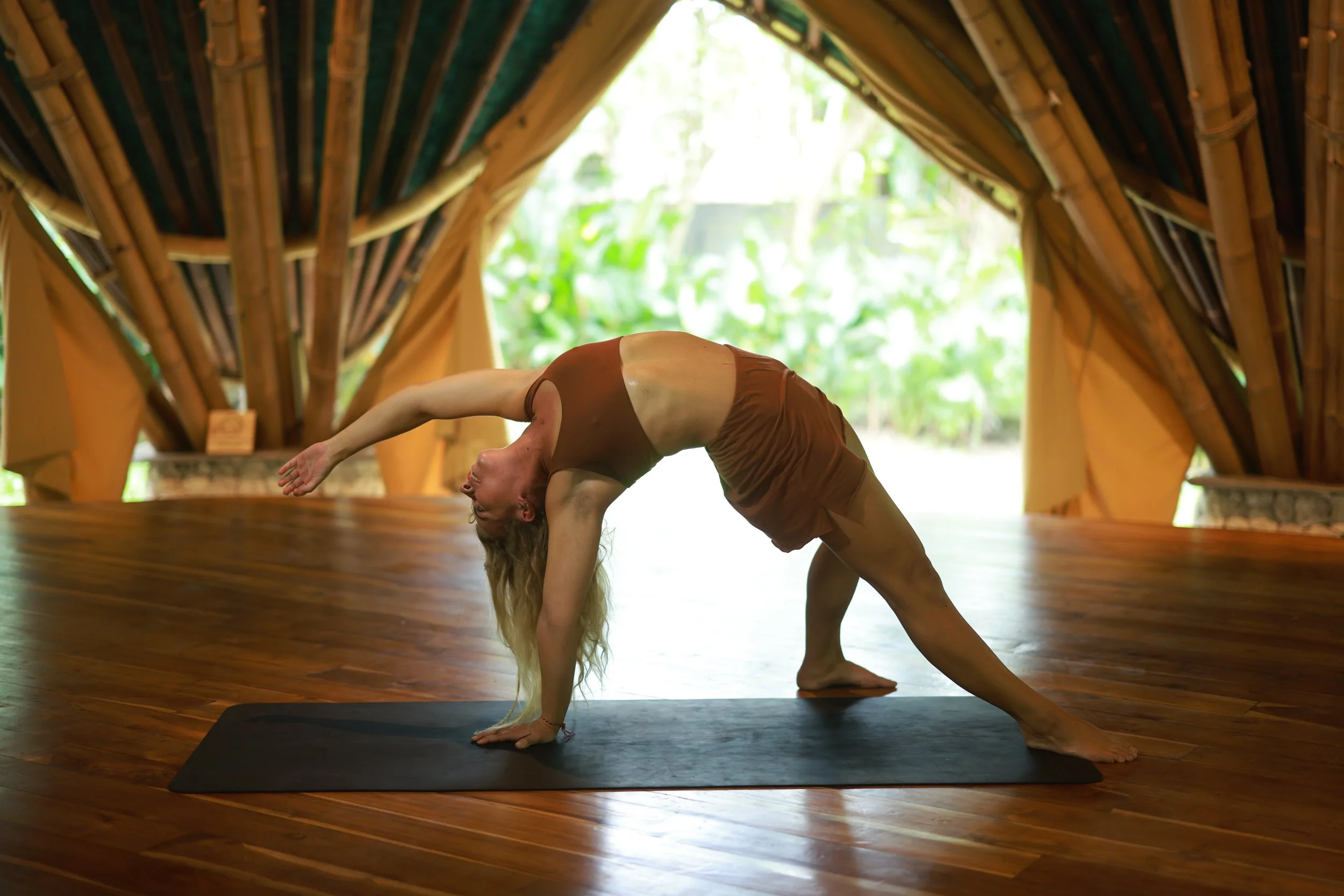
A gentle and restorative practice that emphasized the breath, while exploring postures that nourish the body and mind through long holds, utilizing the support of props and bolsters.
As the name suggests, Air classes strongly emphasize the breath. You can expect gentle postures, often supported with props, with long periods of time in each posture allowing to move through bodily sensations via the waves of breath. Appropriate for both beginners and experienced students, these gentle classes help to restore your mind, body and spirit.
Descriptive Words: light, airy, feel. sense, touch
Earth
Slow Vinyasa Flow, Grow
A foundational class that takes a slow delibrate approach to yoga asana (postures), focusing on a balance of both standing and seated postures, while exploring mantra, breathwork, subtle body practices and meditation. These practices are suitable for beginners and adepts alike.
In our Earth classes, you can expect emphasis on standing poses that help build strength, stability and range of motion. Spending more time in each posture will allow you the opportunity to explore appropriate alignment and breath, while also challenging your stamina. Standing postures are balanced with floor postures, to help create a well rounded physical practice. After getting the prana (energy) flowing through standing and seated postures, students will learn to work that energy throught an assortment of mantra, breathwork and meditation practices. Helping to build a strong base in the foundational practices, these classes are appropriate for both beginners and adepts of the practice.
Descriptive Words: ground, floor, solid, foundation, density, earth, established
Yin
Yin yoga works deeply into our body with passive, longer-held poses.
It targets the deepest tissues of the body, our connective tissues – ligaments, joints, bones, the deep fascia networks of the body and the meridians. This is contrast to a Yang yoga practice such as Vinyasa yoga which targets the muscles.
Energetically, Yin yoga improves the energy flow, enhancing the flow of chi in the organs. To be healthy, we need healthy organs as well as healthy muscles. Yin yoga also offers wonderful emotional and mental help benefits
A Yin yoga class usually consists of a series of long-held, passive floor poses that mainly work the lower part of the body, the hips, pelvis, inner thighs, lower spine. These areas are especially rich in connective tissues. The poses are held for up to five minutes, sometimes longer. Yin is almost entirely passive, although some Yin asanas contain Yang elements. During the asanas, muscles are relaxed to avoid muscle spasm, which could result from engaging muscles for long periods.
Increases circulation and improves flexibility
Calms and balances the mind and body
Reduces stress and anxiety
Releases fascia
Encourages deeper relaxation
Improves joint mobility
Brings balance to the organs through meridian stimulation
Origins and History
Holding stretches for long periods of time and other techniques closely related to Yin yoga have been practised for centuries in China and Taiwan as part of Daoist Yoga, which is sometimes known as Dao Yin. Taoist priests taught this knowledge, along with breathing techniques, to Kung Fu practitioners around 2000 years ago.
Yin yoga is based on the Taoist concept of yin and yang, opposite and complementary principles in nature. Yin is the stable, unmoving, hidden aspect of things; yang is the changing, moving, revealing aspect. In the body, the relatively stiff connective tissues (tendons, ligaments, fascia) are yin, while the more mobile and pliable muscles and blood are yang.
It works on the Yin tissues – also known as the connective tissues. Connective tissue responds best to a slow, steady load. If you gently stretch connective tissue by holding a yin pose for a long time, the body will respond by making them a little longer and stronger – which is exactly what you want. Remember the principle of the exercise is to stress the tissue so the body will respond by strengthening it.
Yin Yoga requires the muscles to relax around the connective tissue in order to get a stretch, so not all yoga poses can be done safely or effectively when practising Yin style. These Yin asanas have different names.
Qi
Yin yoga poses are also designed to improve the flow of qi (chi) the subtle energy that, according to Traditional Chinese Medicine (TCM), runs through the meridian pathways of the body. According to TCM, the improved flow of qi improves organ health, immunity, and emotional wellbeing.